Your Brand Isn't Transmitted. It's Reconstructed.
We marketers often talk as if "brand perception" were a signal being faithfully received, with any gap between intention and perception chalked up to noise or poor execution. The gap, however, is structural because perception has always involved construction, not transmission, so keep in mind your customer's brain is a renderer and not a mirror.

Durable Business Is Built On Patterns
None of this reduces to a formula.
The most successful businesses have found value where formulas say there isn't any. Why? Because formulas optimize for what's measurable now, when it is more valuable to ask what's true regardless of the moment.
Consider growth for a moment. If you chase it above everything, you'll miss asking: Will this business exist in ten years? A company that grows fast but can't defend what it built is just borrowing time because durability is an important test growth has to pass. Distribution illustrates the same idea from another angle. Superior sales and distribution, on their own, can build a monopoly even without a better product.

Incentives, Not Villains
Most marketers still navigate their work with a map that says "the internet is mostly people browsing." Using that map won't get you killed, but it will have you walking toward the cliff. Here is one consequence of the territory beneath us changing in real time.

From Reaction to Decision
The core architecture of most marketing systems is reactive. A user takes an action, the system detects it, and a message goes out. That architecture made sense when consumer behavior was relatively stable and predictable but it breaks down when the behavior you're measuring is itself a response to the system.
• Abandon cart, get a discount
• The trigger fires
• The reward lands
• The pattern locks in
Same Paint. Different Story.
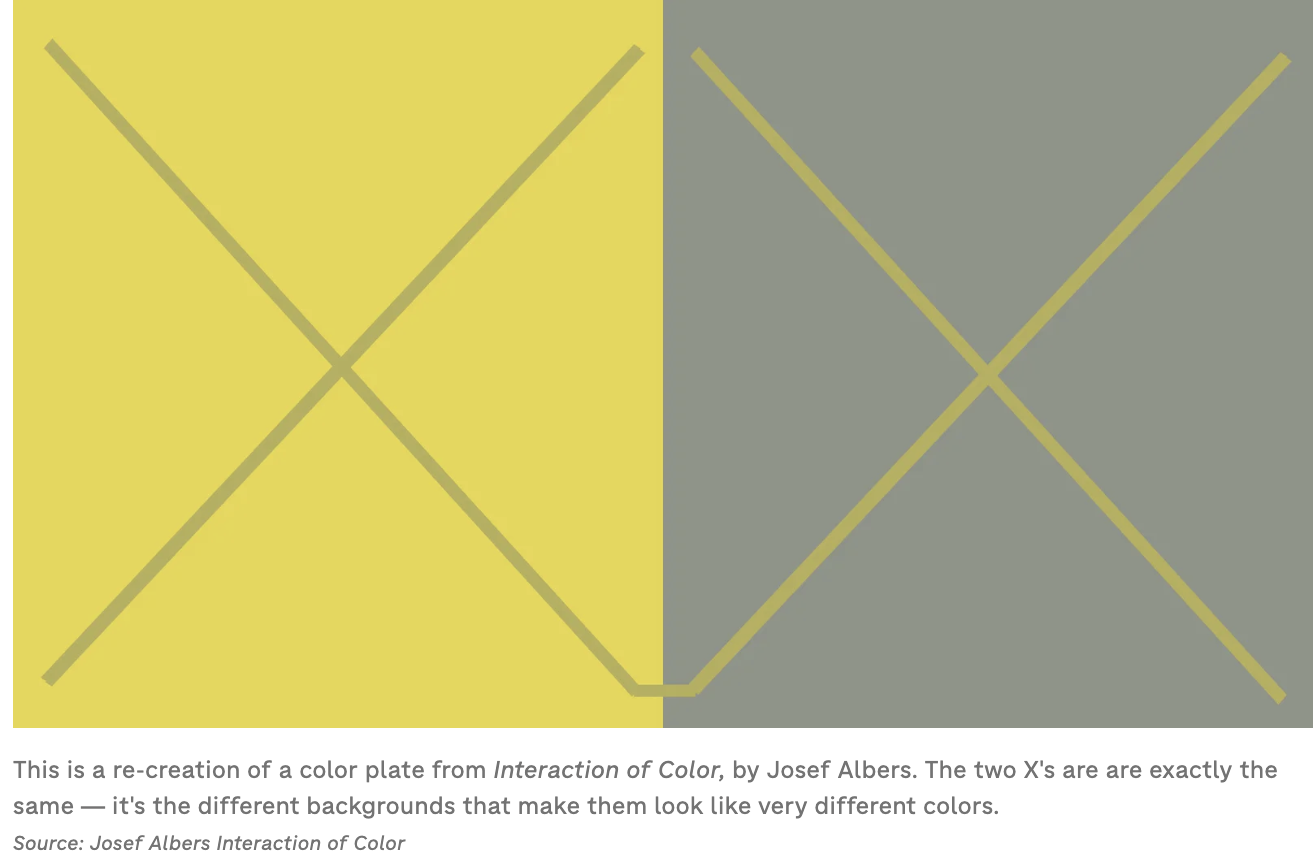
Most of us learned in school that objects have colors, and that their weight and dimensions are fixed, measurable, and inherent. But the science says otherwise. Color is a judgment the brain renders, not a fact it reads. And like every judgment, it is heavily shaped by context. Why does this matter? Let me color in between the lines for you.
Consumer perception works the same way, where people do not evaluate your product in isolation. They evaluate it inside the frame your campaign constructs, be it the background, the lighting, the typography, the whitespace, the adjacent imagery, or the accumulated expectations your category has trained them to carry. This means the same product can feel premium or generic, clinical or warm, trustworthy or forgettable, depending entirely on the perceptual environment you build around it. Therefore, you are not simply designing an object to be seen but also the conditions under which an inference gets made. Here are some ways to create optimal conditions:

Machine Speed Is Easy. Discernment Is Not.
It is a seductive story that has been circulating in marketing: AI can produce content faster than any team, so the advantage belongs to whoever deploys it first and hardest. That story is terrible and should stop being told, mainly because it is solving for the wrong "x". Speed is rarely, if ever, the constraint in great marketing. The hardest part isn't producing the asset but knowing what to say, to whom, in what order, and why it should feel true, sure can be. Interestingly, AI doesn't change that at all.

The Brain Runs Open Loops Automatically.
Give people a set of tasks, puzzles, arithmetic problems, or simple crafts and interrupt half of them before they finish. Then ask everyone to recall what they worked on. The result was consistent and striking: incomplete tasks were remembered almost twice as well as completed ones. The brain wasn't treating finished and unfinished work equally. It was filing completed tasks away and releasing the mental tension around them. Unfinished ones, it kept running in the background, like an open tab that refused to close.
Why You? No, Really. Why You?
Most of us doing marketing skip that question. Not because we're all lazy, but because we're too busy doing things we arguably shouldn't be doing. There's a quota to hit, a pipeline to fill, and a board meeting on Thursday. So we write the website copy, design the brochure, and launch the campaign, all without ever sitting down to honestly answer the one question every single customer is quietly asking: Why you?
If you don't know the answer to that one question, then it is entirely unreasonable to think your customer will. Why, better yet, how would they? And saying you are "innovative," "customer-focused," and "best-in-class" is not a correct answer. One could convincingly argue that they are the absence of one.

The Narcissist At The Podium
Once you see it, you can't unsee it. They walk onto the stage or into your feed with the posture of someone who has already won. The bio is long. The testimonials come first. Before they've said anything of substance, you already know they've been featured in Forbes, built three companies, and "helped thousands of people unlock their potential." We lean forward into the message to hear more.

Why Listening Works When Empathy Fails
We're living through an era saturated with empathy, or at least, the performance of it, where organizations champion psychological safety, leaders demonstrate vulnerability, and entire frameworks are built around understanding feelings. Yet for all this empathetic effort, people seem more entrenched in their positions than ever. That seems odd. Or is it?
This may just be what happens when empathy becomes unproductive, and the goals shift from understanding to validation and clarity to comfort. When we elevate the mere expression of concern over the harder work of actually moving something forward, we end up with a dynamic in which society prizes victimhood and avoids accountability, in which being understood matters more than being challenged.

Where Does Marketing Actually Live?
Most organizational charts lie about how marketing works through clean boxes and reporting lines, but they hide the real question of where marketing ends and everything else begins. The answer matters because unclear boundaries create confusion and conflict that masquerade as strategy disagreements:
• Sales complains marketing doesn't deliver leads.
• Marketing complains sales don't follow the narrative.
• Product says marketing overpromises.
• Strategy says marketing doesn't understand the market.
Personality conflicts? Maybe a fraction, but they're symptoms of undefined decision rights and a misunderstanding about marketing being the translation layer between strategic intent and market reality. How so?

Ask Follow-up Questions
That is probably obvious.
But asking open follow-up questions is one of the easiest ways to uncover deeper insights about how your marketing campaigns resonate with your target audience. Of course, the principal difficulty with them is coming up with the questions themselves in the moment. I've shared a range of questions that are widely applicable across many marketing research conversations.

The Cost of Imprecision or Why Precision Matters
Marketers routinely invoke psychological concepts to explain consumer behavior and design campaigns. We speak about "creating FOMO," "leveraging social proof," and "avoiding cognitive dissonance." But many psychological terms don't mean what marketers think they mean.
Misunderstanding psychological mechanisms leads to misapplied strategies, wasted budgets, and failed campaigns. Worse, it leads to unethical practices based on flawed assumptions about how influence works.

Stop Guessing And Start Asking
We don't misunderstand our customers because we lack intuition. We misunderstand because we don't ask. You might feel like you know your audience well enough to understand how they think, what they want, and how they make decisions. You don't. Did you know that people in relationships who assumed they already understood someone were no more accurate than strangers at decoding ambiguous statements? The relationship didn't increase accuracy, but it increased confidence. Let's allow that to percolate for a moment.

Your Decisions Are Shaped Before You Ever Make Them
Your Decisions Are Shaped Before You Ever Make Them
We marketers have built entire functions around the assumption that choice happens in the moment, at the shelf, on the landing page, during the demo. Unfortunately, choice isn't a point-in-time event. It's the endpoint of a long chain of impressions, exposures, and associations accumulating long before your customer enters an active buying cycle. You're probably thinking this is just semantic. It's not. Why? Because you aren't just competing for attention in-market engineering, you're trying to shape the mental habitat in which their selection feels inevitable.