
Navigating the Weight of Past Investments
The weight of past investments creates powerful psychological anchors. Marketing executives often face resistance not because the new approach is flawed, but because stakeholders feel the pain of "abandoning" previous investments more acutely than they feel the potential of future gains.

Recognize When Something Is Ready Enough to Serve Its Purpose
Recognize when something is ready enough to serve its purpose. The people we get to work with, especially in marketing often forget that every piece of work is an iteration, not a final destination. You create work that matters. Now go and see who else thinks so by launching it into the world.

Don't Omit The Omission Bias From Your Thinking
Instead of highlighting what your product does, emphasize what prospects lose by not acting. Frame inaction as the risky and therefore uncomfortable choice.

Do you want to be right or remarkable?
Enemy Number One Of Innovation? Your Ego.
Imagine looking at the wall where your brilliant campaign strategy is laid out. You're certain it's going to revolutionize everything and crush the competition into oblivion. Certain.
Poppycock! Certainty is the enemy of innovation.

There Is No Secret Formula. That's The Secret Formula.
Give yourself options rather than being beholden to preordained steps especially if any expert or guru proclaims "that's how it's always been done".

The Map Is Not The Territory. The Marketing Is Not The Market.
We're not just competing for attention; we're exploiting fundamental neurobiological circuitry that evolved over millions of years. The orienting response – that automatic head turn toward novel stimuli – wasn't designed for massive digital billboards along the highway or infinite scroll feeds. It was meant to help us spot predators and potential mates.

The Forge of Ambition
No diversions. No distractions. Just relentless, intelligent, and pragmatic work. When a potential partnership emerged that could crush competition and create market dominance, she didn't hesitate. Old rivalries meant nothing compared to strategic advantage.

Beware The Subadditivity Effect*
Sometimes, you have to let people fall in love with your product one feature at a time.
Breaking down a product's value proposition into individual, meaningful benefits can help customers better appreciate its total worth, counteracting their natural tendency to undervalue combined probabilities or features.

Ignore this at your own peril
Are you trying to optimize your marketing campaign but not sure what to optimize? Try one, two, or all of these. Maybe not at the same time as optimizing for many can hurt the optimization of one. More on that later.

Understanding Feedback Loop Acceleration
It would be best if you shortened your marketing feedback loop. How do you do that? First, you did a good job recognizing that every delay represents a risk and an opportunity cost. Traditional marketing often relied on quarterly reviews or monthly analytics, but now such delays are practically prehistoric.

Data Can Speak To You If You Know How To Listen
The iterative marketing strategy process works. All you need to do is observe, analyze, hypothesize, experiment, measure, and adapt.
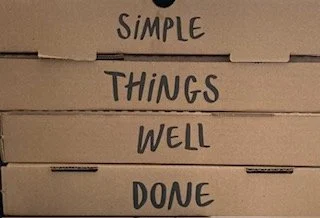
Defend The idea or optimize the result?
Your greatest competitor isn't another brand. It's your unwillingness to be wrong.
Every time you defend a marketing campaign to protect your ego, you sacrifice genuine learning. Every moment spent proving your point is a moment stolen from understanding your customer's true perspective.
Marketing isn't about being right. It's about being effective.


Here's What Happens When Elephants Ride Unicycles
The gap isn't about money. It's about courage.
The small agencies are waiting for permission, waiting to see what works, waiting for the path to be clear. Meanwhile, the giants are buying their way into the future, hoping money can substitute for insight. But here's what they all might be missing: AI isn't a destination. It's a unicycle. The question isn't "How much should we spend on unicycles?" The question is "Where do we want to go, and how can this unicycle help us get there faster?"

Let Me Tell You About The Four Doors
Imagine you're standing in a hallway and in front of you are four doors, each revealing something different about the choice your customer is about to make.
Door One shows what wonderful things await if they say 'yes' – let's call this the Rainbow Door. Door Two reveals what problems disappear with 'yes' – the Vacuum Door. Door Three shows what troubles come if they say 'no' – the Storm Door. And Door Four displays what good things they'll miss by saying 'no' – the Farewell Door."
Admit it, you're intrigued.